Building Shiplog: From Idea to MVP.
How I went from a vague problem to shipping a real product - and what I learned along the way.
Date
April 2026
Build Time
4 weeks
Status
Live
Context
The Core
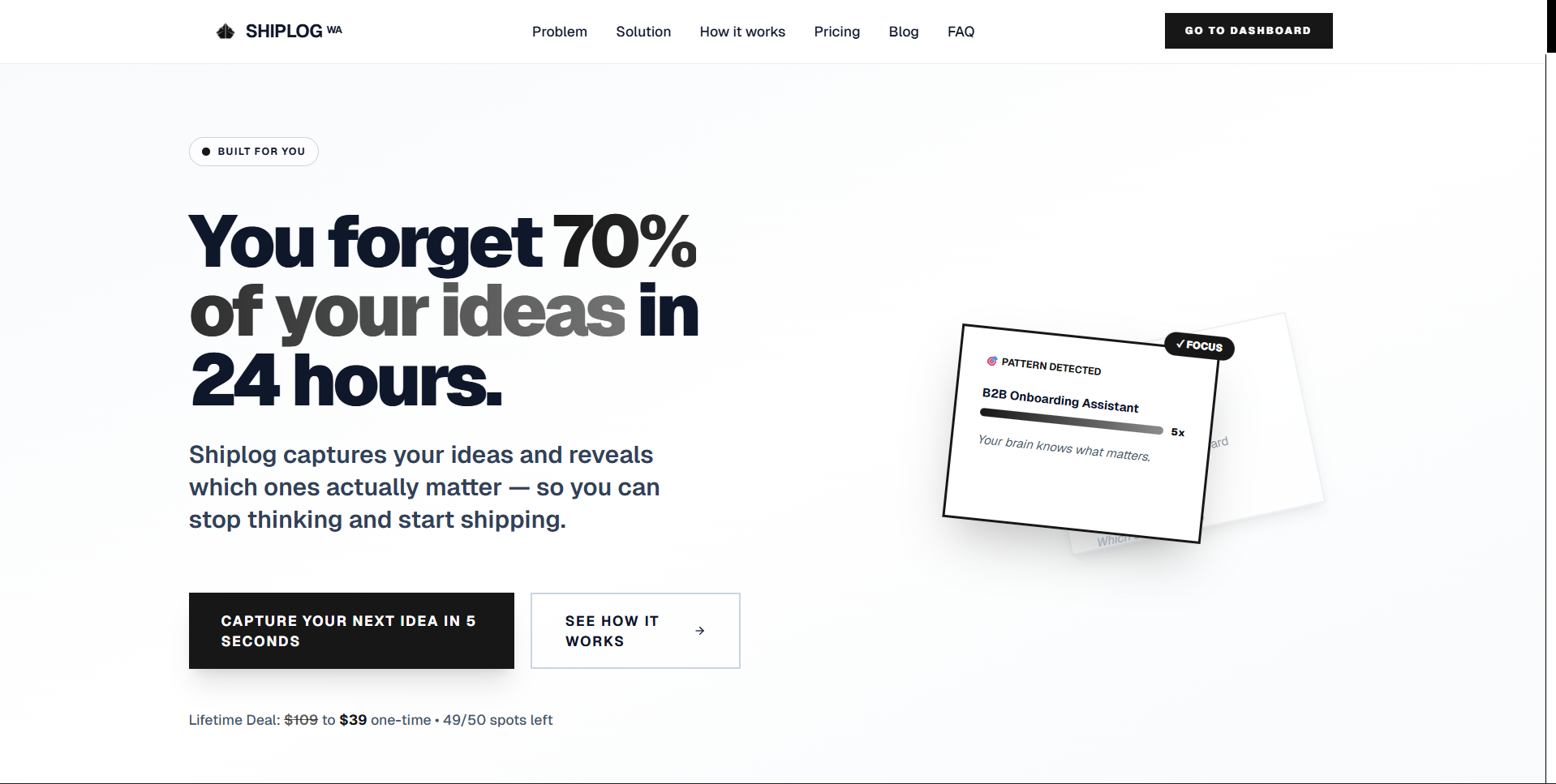
Shiplog is a tool to log any and all ideas and track thought recurrence.
Audience
Individual Developers and Solo Founders that have an abundance of ideas but lack a system to prioritize them.
Why?
To help individuals and solo founders capture their ideas and focus on the ones that actually matter.
The Idea
“Whatever you are thinking right now, just start on it. Do not wait for the right momennt. Just start.”
The Origin
The idea for Shiplog came from my own struggle with idea overload. I had countless project ideas but never started any of them, waiting for the 'perfect' time and idea. Now I want to turn shiplog that helps beyond just Idea selection.
Core Assumptions
- → People have more ideas than they can execute on.
- → A simple logging and ranking system can help prioritize ideas.
- → One Ship > 1000 Ideas
Build Process
Rough Concept
Needed a simple to do list to capture any and all ideas. The focus was on speed and ease of use, with the core feature being the ability to quickly log an idea and re-log it when it comes up again.
function logIdea(idea) {
  const existing = findExistingIdea(idea);
  if (existing) {
    existing.count += 1;
    existing.lastLogged = new Date();
  } else {
    ideas.push({ text: idea, count: 1, lastLogged: new Date() });
  }
}The MVP Core
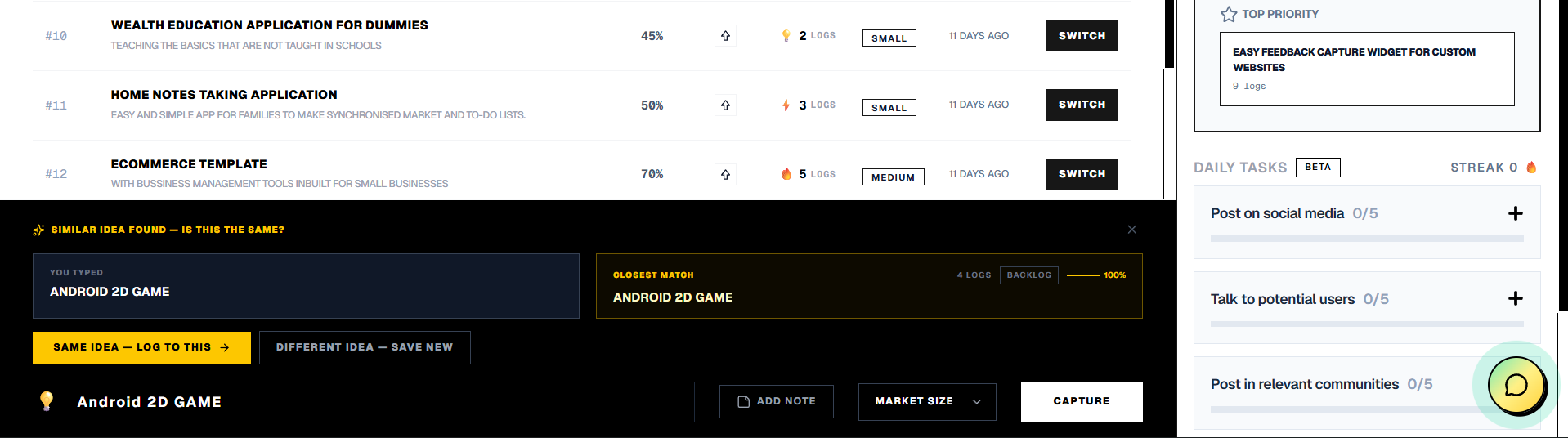
The first version is focused solely on the core logging and ranking functionality. It is a barebones interface that allowed users to log ideas, see them ranked by frequency and other factors. The goal was to get something functional in front of users as quickly as possible.
Key Decision
Focus on the core logging and ranking features, and defer any additional features or polish until it becomes useful for me.
Trade-off
Created a minimal interface that makes the problem look like non-existent.
Polish before Launch
Before launching, I added some basic UI polish and a few small features to make the experience more usefyll. This included things like a progress log, and build mode and Social sharing features.
Validation & Reality
No formal validation was conducted. I just started building based on my own pain point.
“The best way to validate an idea is to build it and see if it solves your own problem.”
What Worked
- • Minimalism
- • Fast Building
- • Personal Usage
What Didn't
- • No early validation
- • Unclear retention
- • Value prop assumptions
Challenges
Defining the Core Problem
The initial problem statement was vague and broad. It took some iteration to narrow it down to the specific issue of idea overload and the need for a simple logging system.
Defining Ship vs Idea
The concept of 'shipping' an idea was initially unclear. I had to define what it meant to 'ship' an idea in the context of Shiplog, and how that would be reflected in the product's features and user experience.
How can Shiplog be more than just a to-do list?
Planning and Preparation to a bigger tool has started to take shape. The challenge is to add features that enhance the core value of logging and ranking ideas without overcomplicating the product or losing the simplicity that makes it appealing.
Outcome & Key Learnings
The Current State
The MVP is live and functional. It solves my personal problem of feeling busy but not sticking to my commitments, but it is still very early. The focus now shifts from does it work to is it valuable for others.
Key Learnings
- 01 Building fast > Stuck thinking.
- 02 Clarity comes from usage.
- 03 Solve your own problem first.
- 04 Distribution > Building.
Next Steps
- / Iterate based on feedback.
- / Refine the value proposition.
- / Focus on distribution
MVP
Current Phase
1
Happy User (me)